A building beside a big lake has one thing in common with a building beside a big parking lot: nothing stands between it and the wind. Lakeside City sits on the south shore of Lake Wichita, which covers about 2,200 acres, and it lies roughly eight miles southwest of downtown Wichita Falls, TX. Any commercial roof there deserves a careful look at its edges, because the edges are where an open approach does its work.
Step one is the building itself: its use, its age and what has been done to the roof before. Step two is a walk across the whole surface. Step three is a short written list, with photographs, that separates what needs work this year from what only needs watching.
Start at the Edge
Wind finds the weakest line on a roof, and that line is nearly always the perimeter. The metal edge, sometimes called coping or drip edge, holds the membrane down along the outside. If that metal loosens, the sheet beneath it can lift, flutter and tear in a strong gust.
We check the edge metal for gaps, the fasteners behind it for back-out, and the first few feet of membrane inside it for lifted seams. A simple test is to press along the edge by hand and feel for movement. Loose metal is a quick fix when found early, and the work belongs with edge metal and coping repair. Found late, it can mean replacing a whole run of membrane.
Sun on a Dark Membrane
A typical year in Wichita Falls brings about 28 days at 100 degrees, and the lake does not change what a dark roof does on those afternoons. A black or gray membrane absorbs heat, expands, and then relaxes after sunset. Across years, that cycle wears at seams and at the corners of flashings.
A light-colored membrane or a reflective coating can lower the surface temperature, and it helps most on buildings with a lot of cooling load. We look at whether a cool roof makes sense for the building, or whether the existing surface can carry a restoration coat instead. The answer depends on the condition of the membrane underneath, not on color alone.
Hail Records and Hail Marks
Weather-service records show golf-ball stones falling on Electra for a full fifteen minutes in March 1982, with damage out to Burkburnett, and baseball-size stones on Iowa Park and Burkburnett in April 1991. Those records belong to those towns. They show that this corner of North Texas can produce large stones, and they say nothing yet about a roof in Lakeside City.
For a roof here, the useful question is what hail left on it. A hail bruise shows as a dished, soft spot, and it may not leak for months. We press across the field of the roof, mark each spot with chalk, and photograph it. A roof with scattered bruises may need a hail damage repair and a record for the insurer. A roof with none gets a clean report, which is also worth having.
Where the Water Goes
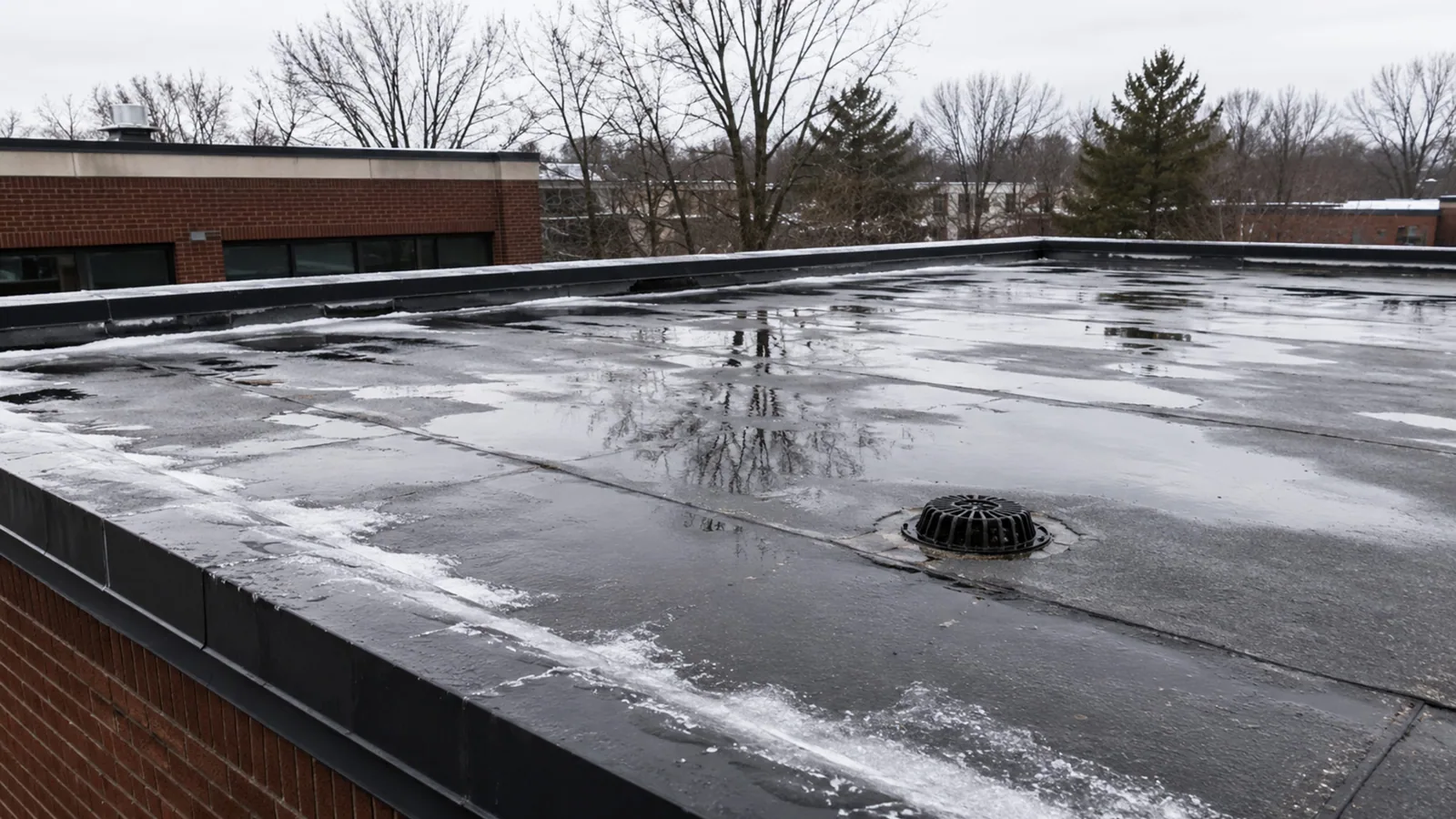
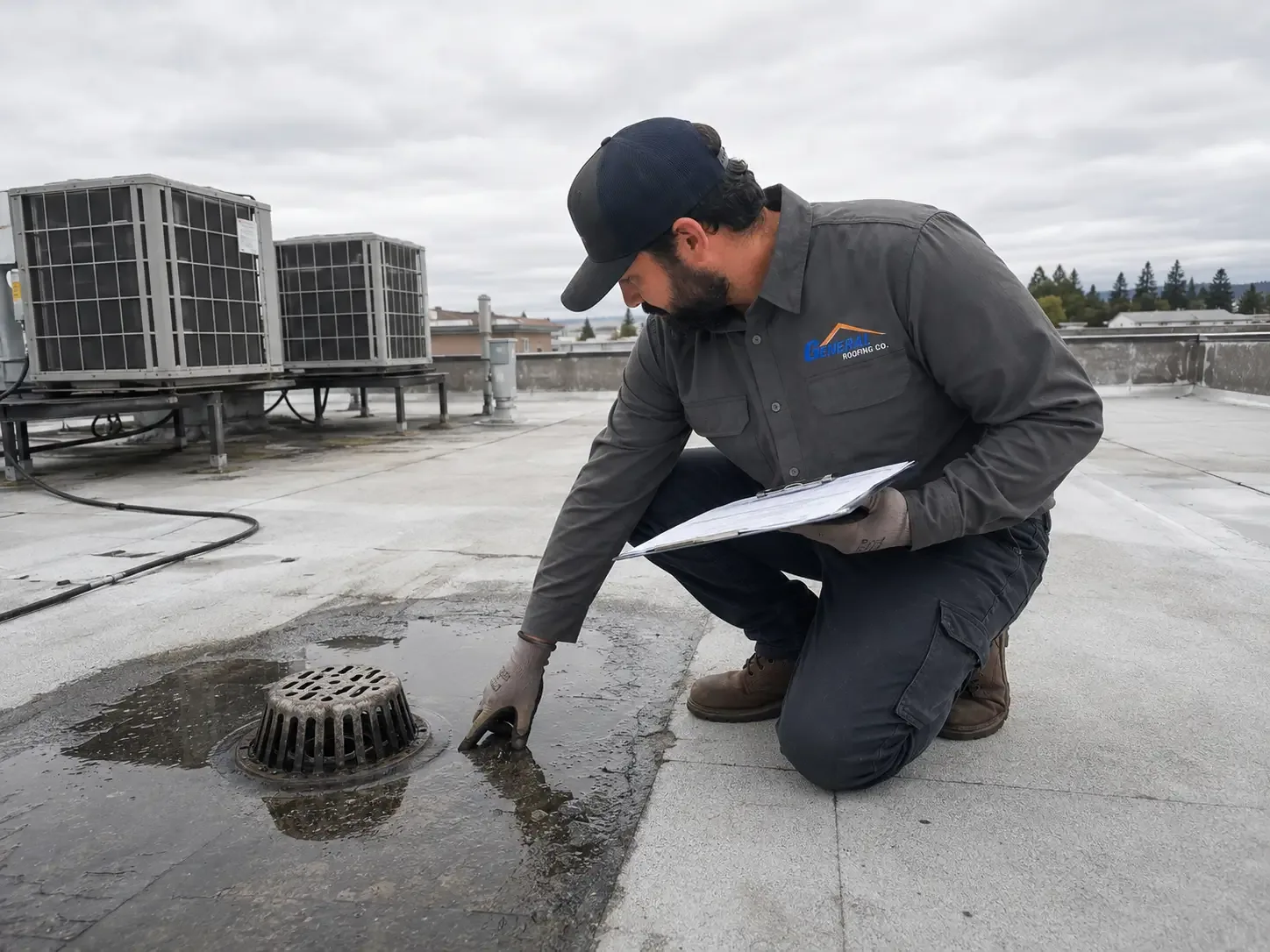
Low-slope roofs shed water slowly, and the drains, scuppers and gutters decide how much of it lingers. After a rain we look for a ponding line, the pale ring that shows where water stood. Water that stays longer than a day or two puts weight on the deck and speeds up the wear on the membrane under it.
The fix may be as simple as clearing debris from a scupper. It may also be a tapered insulation addition that moves water to the drain, or a new drain body. Our work on ponding water starts with measurement, because the cure for a clogged drain and the cure for a sagging deck are not the same.
The First Walk, Step by Step
Step one is the penetrations: every vent, pipe, curb and rooftop unit is a hole in the membrane, and each has flashing that can crack or pull loose. Step two is the seams, where sheets join and where heat and wind both do their slow work. Step three is the field of the roof, where we press with a gloved hand and a probe to find soft spots that may mean wet insulation underneath.
On a metal roof the list changes. We look at panel laps, sealant at the ribs, fastener heads that have backed out and rust at cut edges. A commercial roof inspection ends with photographs of every finding, a plain description of each and a ranking by urgency. Nothing in the report is a surprise on the day we talk it through.
Access Along State Highway 79
State Highway 79 runs along the southeastern edge of Lakeside City toward Archer City, so trucks reach the area without crossing the busiest parts of Wichita Falls. We plan material deliveries around the building, not the highway: where the hoist stands, where debris goes and which hours the building can tolerate noise.
The same planning applies at Archer City and at the southwestern side of Wichita Falls near Southmoor and Sun Valley. If tenants are inside, we schedule loud work for their quiet hours and keep walkways clear. A written plan for access goes to you before the first truck arrives.
Repair, Recover or Replace
One clean rule helps here: fix what is wrong, and no more. A small tear in a sound membrane is a repair. A roof with dry insulation and a tired surface can sometimes take a coating or a recover, while one with wet insulation across a large area usually needs the wet material removed.
Pricing follows roof size, the wet area, the number of penetrations and the difficulty of reaching the roof. We list each item in the report as patch or fix, with its own price, so you can decide one item at a time.
Commercial Roofing Questions
Does being near a lake change how a roof should be built?
The roof itself is built the same way. What changes is attention to the edges, because open ground gives wind an easy approach. We check the perimeter metal and fasteners first, then the seams that sit close to it.
How far is Lakeside City from your Wichita Falls base?
About eight miles southwest of downtown Wichita Falls, which makes a same-day walk practical. We can usually arrange a visit around your hours and send the written report soon after.
A roof leaks only after a heavy rain. Where do we begin?
At the lowest point and the nearest penetration. Heavy rain finds drains that are slow, flashing that has opened and seams that need attention. We trace the leak uphill from the stain and confirm with moisture readings.
Is a coating a fair alternative to replacement?
Sometimes. A coating works when the membrane is sound and the insulation is dry. We test first, and a replacement answer comes with its reasons in the report. A coating is a surface treatment, so it cannot hide wet insulation or a deck that has lost its slope. The test comes first, and the decision follows the result.
Can you work while my business stays open?
Yes. We section the roof, keep one area closed at a time and set up debris chutes away from doors. Tell us your busy hours and we will plan around them. Rooftop units stay in service, so we protect intakes from dust and coordinate any shutdown with whoever maintains the equipment.