A school district has a calendar before it has a roofing plan. Buildings are occupied from August to May, classrooms sit under the roof every day, and the quiet window for real work is a few weeks of summer. So the one rule worth remembering is that the schedule decides the scope. Roofs that cannot be finished by August should be broken into phases that can.
In the Wichita Falls, TX area, Wichita Falls ISD ranks second among employers, and smaller districts such as Iowa Park CISD, Holliday ISD, Henrietta ISD and Petrolia ISD serve the towns around it. We inspect low-slope and metal school roofs, write down what each campus needs, and plan the work so students, staff and the board calendar are respected.
Treat each campus as its own file
Start with the building. A district may own an elementary school, a middle school, a gym, a bus barn, an administration office and a stadium press box, and each has a different roof. Even two schools built in the same decade can differ, since additions, equipment and past repairs change what is on top. A district-wide average hides the roofs that matter most.
We keep a short file for every roof: age as far as it is known, membrane type, drainage, penetrations, past leaks and past repairs. Then we rank the roofs by consequence, not by age alone. A gym roof with a slow leak over a finished floor outranks a storage shed with a stain. That ranking is the starting point for a multi-year plan, and it lets a board see why one campus comes first.
Athletic and support buildings deserve the same attention as classroom wings. A field house, a coliseum or a maintenance barn often sits outside the daily routine of administrators, so its roof is the one that leaks for months before anyone files a work order. We add those buildings to the walk list on the first visit and note what they hold underneath, because a wet equipment room is a safety question as well as a roofing one.
What heat and hail do to a school roof
Texas summers are hard on any roof. A normal year here adds about 28 days at 100 degrees, and 2011 made Wichita Falls the first Texas city to reach a hundred such days. A dark membrane flexes through each of those days, and seams, flashings and sealants take the strain.
Hail is the other test. Hail hit Burkburnett and Iowa Park hard in April 1991, and in March 1982 golf-ball stones piled up in Electra for a quarter of an hour. Those events are history and do not prove damage on a given campus. They are a reason to inspect after a severe storm. A hail bruise often cannot be seen from the ground, so we press, probe and mark it, then photograph it for the district file.
Wind is the third pressure. A school roof has long perimeter runs, parapets, canopies over entrances and gym roofs that stand taller than the buildings around them. We check edge metal, coping and the attachment of canopy roofs, since a loose edge is where uplift starts. After any storm with strong wind, a quick walk of each campus catches lifted flashing before the next rain turns it into a classroom leak.
Repair now or replace in phases
One clean rule applies: repair what is dry, replace what is wet. A roof with isolated splits and sound insulation can carry on after a repair, and commercial roof repair buys time to plan. A roof with spreading moisture needs a replacement, and large campuses are best done in sections so one wing can be finished and closed before the next opens.
Where the structure and the budget allow, a recover over a sound roof or a restoration coating can extend life with less noise and less debris than a tear-off. Reflective systems such as TPO also lower heat gain on the roof surface. The right answer depends on what is under the membrane, which is why we look there first.
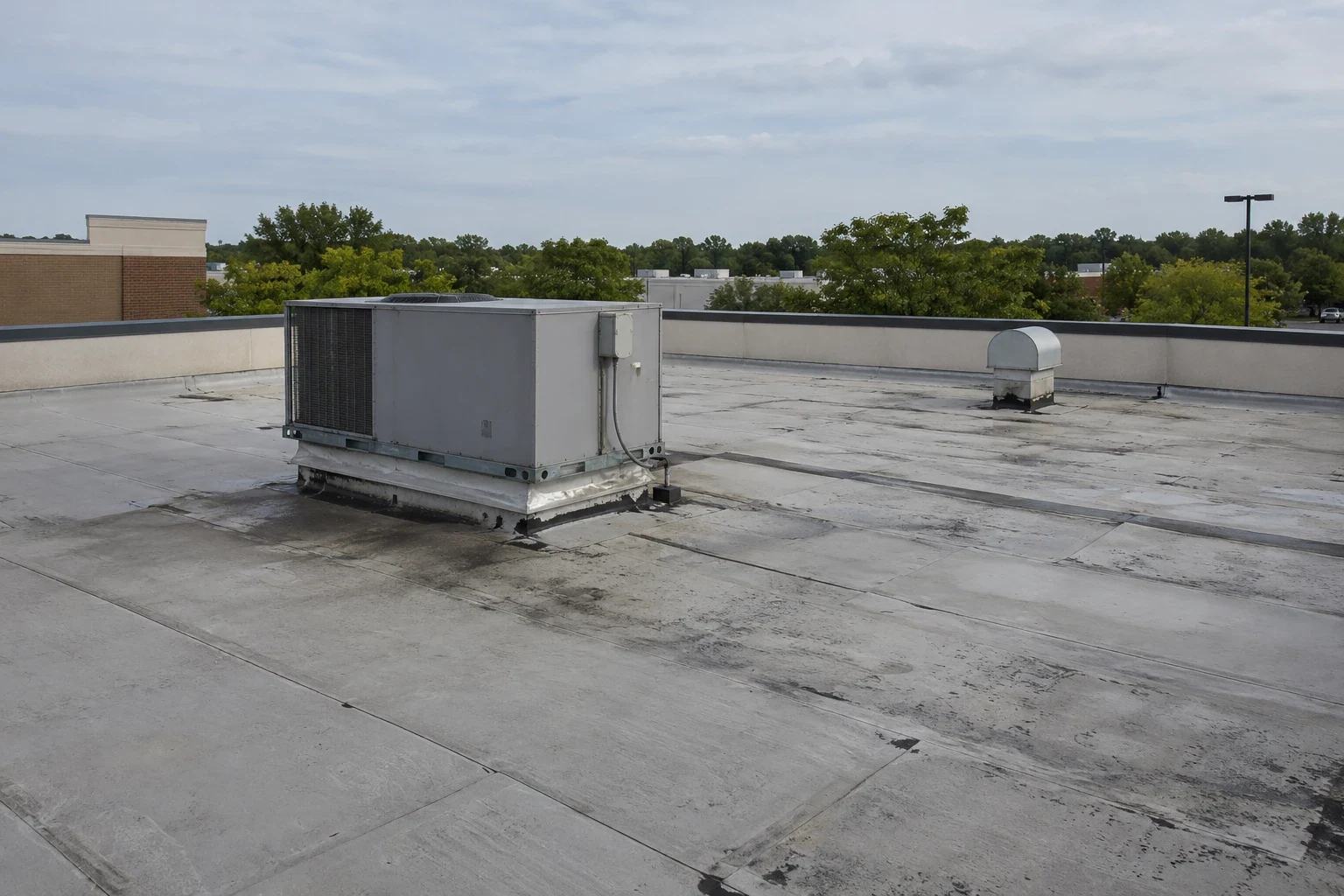
Mechanical equipment adds its own wear. Rooftop units serve classrooms, kitchens and gyms, and each service visit puts feet and tools on the membrane. We look at walk pads, curb flashing and condensate lines, and we recommend protective pads where traffic is heavy. These small items cost little next to a membrane patch, and they are the first thing a good maintenance record should list.
Fit the work into the summer break
Summer is short, and rain does not care about the board calendar. We plan material orders, crew start dates and weather delays early, so the roof is watertight before classes return. Noise from tear-off is scheduled away from summer programs and offices that stay open. Dust, debris and truck routes are managed so parking lots and playgrounds stay usable.
Not every problem waits for June. If a storm opens a seam over a classroom in October, we respond day or night, any day of the year, with emergency roof repair that stops the water and protects the room. The permanent fix is then scheduled for a break. In towns such as Iowa Park and Holliday, where one district may run only a few campuses, a single failed roof is a large share of the plant, so phasing and clear records matter even more.
Records a board can read
Boards and business offices need a document they can follow without a roofing background. Our report names each roof area, shows photos, gives a plain condition rating and lists what we recommend: leave, patch or plan to replace. Costs are described by driver, such as access, size, removal and the number of penetrations, with specific numbers added when a scope is written.
Many districts work with architects and construction managers on larger projects. General contractors and our crew settle tie-ins and flashing details together, and we keep the paperwork in the form that public agencies need for their own files. A clean file helps the next business manager understand what was done and why.
Commercial Roofing Questions
How should a district rank its roofs?
Rank by what sits below and how bad the condition is. A leak over a gym floor or a computer lab comes before a stain in a storage room. Age matters, but condition and consequence matter more.
Can a roof be replaced between May and August?
Many can, if materials are ordered early and the scope is sized to the window. Large campuses are often split into phases across two summers so the work is neither rushed nor left open.
Does the Iowa Park hail event of 1991 mean our roofs are damaged?
No. It tells us hail has reached this part of Texas before, so an inspection after a severe storm is sensible. Only a walk on your roof shows whether bruises or cracks are present.
What should a business office send before the first walk?
Send roof ages if known, past repair invoices, leak logs and the campus list. A site plan marking which buildings have flat roofs is helpful. We shape the first visit around that list.
Can a coating avoid a full replacement?
Sometimes. A coating suits a roof that is dry, sound and not too far gone. We test the roof first, since coating over wet insulation only hides the problem.
Who inspects a roof after a hailstorm, and when?
A roofer walks it as soon as it is dry and safe. We photograph bruises, cracks and dented metal, mark their positions and write a report the district can share with its insurer or board.